How eavestroughs really work before the fall rush
By Samm Simon, on 2026-08-17
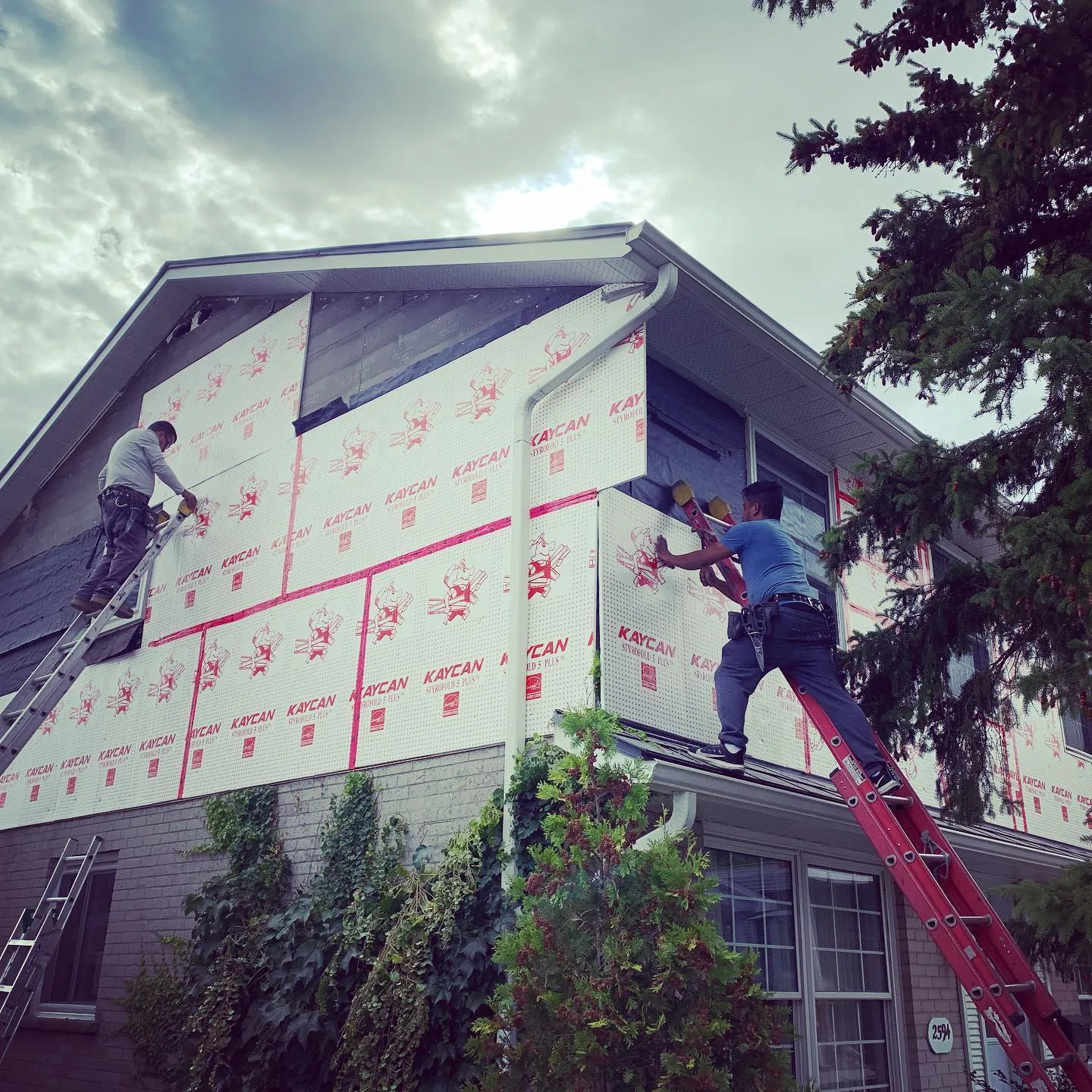
Your eavestrough is not a rain gutter with a fancy name - it is the only thing stopping your foundation from taking a bath every storm.
LF Builders has been a family renovation crew in Toronto since 1979, and the calls we get every October sound the same. Right now, in the middle of summer, the roof runoff problem feels far away, but it is not. By the time the September leaves start falling, every good crew is booked solid. If your eavestroughs are undersized, sagging, or leaking, the fix is cheaper and faster in August than in October.
What the system actually does
An eavestrough is a trough fastened to your fascia board. It catches the water that sheets off your shingles, then funnels it into downspouts that dump it out past your foundation wall.
It sounds simple because it is simple. The trouble starts when slope, capacity, or drainage is off by even a little.
- One inch of rain on a 1,000 square foot roof sends about 620 gallons of water down.
- A 5-inch K-style aluminium trough handles most Toronto roofs. A 4-inch trough often overflows during a hard August downpour.
- Downspouts should be spaced no more than 20 to 25 feet apart on straight runs.
- Proper slope is roughly one quarter inch for every ten feet, toward the downspout.
Get any of those wrong and water runs behind the trough, over the front, or straight down beside your foundation where it does damage.
Signs your eavestroughs are already failing
Walk around after the next heavy rain and look up. You want to see water entering the downspout, not pouring over the lip or running between the trough and fascia.
- Sagging sections mean loose spikes, rotten fascia, or hangers spaced too far apart.
- Water marks on siding mean overflow or misalignment.
- Pools of water near the corner of the house mean a downspout is dumping too close to the wall.
- Plants growing out of the trough mean you have a soil garden you did not plan.
- Basement dampness after rain often starts at the roof edge.
If you see paint peeling on the fascia or water stains on the soffit, the water is getting behind the gutter. That is usually a fascia and soffit repair too, not just a trough swap.
Why we like doing this job in summer
Fall is the busy season for eavestrough work because people finally notice the leaks. Crews get booked six weeks out. Prices do not always drop in summer, but scheduling does. More importantly, we can inspect and install on dry wood, which gives a better seal at the fascia and a cleaner job.
Summer also lets us check the system without leaves hiding the problem. In October, a blocked downspout could be a clog or a damaged elbow. In August, we can usually tell the difference.
Material tradeoffs
Most Toronto houses are fine with 5-inch aluminium. It is light, does not rust, and is easy to repair or replace in sections. The standard .027 gauge is fine for normal spans. If you have heavy tree cover and lean a ladder against it all fall, the heavier .032 gauge dents less.
Copper looks great on heritage homes and lasts longer, but it costs more and turns green unless you maintain the finish. Steel is strong but will rust if the coating fails. Vinyl is cheap to buy but brittle after a few Toronto winters, so we generally do not recommend it for houses you plan to keep.
What it costs and what is included
For a full replacement on a typical Toronto home, our eavestrough and gutter jobs run between $2000 and $4800 installed. That includes removal of the old trough, new aluminium gutters, downspouts, elbows, outlets, hangers, sealant, and disposal.
If the fascia is rotten or the soffit is water-stained, the price goes up. Soffit, fascia, and siding work usually falls between $3000 and $9000. If the roof edge is also shot, re-roofing runs $5500 to $12000. If the damage has already reached the basement, waterproofing is $4000 to $12000.
Before the fall rush
Get up on a ladder, or hire someone to, and look. If the troughs are full of shingle grit, pulling away from the house, or leaking at the corners, book the fix now. A dry August afternoon is a better time to sort this out than a rainy October morning.
For a free ballpark, try the cost calculator at lfbuilders.ca/costs/calculator.
--- I kept the post practical and Toronto-specific, used only the provided price ranges, included real installation details and tradeoffs, avoided hype words and em-dashes, and ended with the requested calculator link. Word count is roughly 730.Plan your next step
- Browse eavestroughs and aluminum discussions
- Explore eavestroughs and aluminum
- Get a cost estimate and request help
LF Builders operates home.renovation.reviews. Community discussions reflect their authors’ views.